

The nursing shortage crisis in the United States has reached an alarming proportion, transforming from a workforce issue into a persistent structural problem that is threatening the very foundation of hospital care delivery. With the American Nurses Association projecting a need for more than 1.2 million new registered nurses by 2026 to address existing shortages and growing demand, this blog helps analyze the nationwide challenge of maintaining quality care and operational stability.
The Dimensions of the Crisis
The ongoing shortfall can be attributed to a perfect storm of events happening all at once. An older nursing population has pushed the retirement rates higher, with around 30 percent of registered nurses above the age of fifty. The COVID-19 pandemic made this situation worse, as many skilled nurses retired early after dealing with high levels of stress and burnout. In a survey conducted in 2023, 34 percent of nurses said they were very likely to leave their jobs in the next 12 months, with burnout being the strongest reason for it.

Adding to these facts is the lack of institutional capacity for nursing education programs. Although the number of professionally qualified applicants has been at an all-time high, nursing schools had to refuse more than eighty thousand applicants in 2022 because of a lack of teaching staff, insufficient clinical placement slots, and funding limitations. This describes a case in which, although the need for nurses is constantly increasing, the availability is unrealistically limited.
Impacts on Hospital Operations
These shortages have operational consequences that affect all parts of the hospital system. Most worrying is the decline in nurse-patient ratios, which is a marker of performance in healthcare delivery that is directly associated with outcomes. Many hospitals supposed to work at 1:4 or 1:5 ratios in medical-surgical units now routinely function with 1:7 or higher ratios. Such levels of use are referred to as stressed and have secondary and tertiary effects on the entire system of care.
Overtime that is not voluntary has become the new normal, as nurses and other staff routinely work 12-16-hour shifts. While this helps mitigate some short-staffing issues, it leads to greater fatigue and less attentive care, which increases already high levels of burnout in the workforce. Additionally, there are considerable costs involved with such approaches, as paying employees overtime to cover their shifts adds even more burden on the already strained hospital budgets because of increasing supply expenses and new payment models.
As a temporary measure, numerous hospitals have resorted to employing travel nurses, only to face new challenges with this approach. The costs and complications stemming from travel nurses are far greater than hiring local staff nurses, seeing that travel nurses are paid on average two to three times the amount of staff nurses. A Midwest community hospital reported spending $12 million on travel nurses in 2022 while only treating a smaller number of patients compared to 2019. Some nurses also reported feeling overworked and underappreciated because of the financial burden that came with this fact.
Patient Care Implications
The relationship between nurse shortages and patient outcomes is well-documented in the literature. In an extraordinary study published in the New England Journal of Medicine, it was discovered that every additional patient above optimal ratios assigned to a nurse increased patient mortality by 0.7%. More recent studies continue to affirm very strong relationships between understaffing and medication errors, patient falls, hospital-acquired infections, and readmission rates.
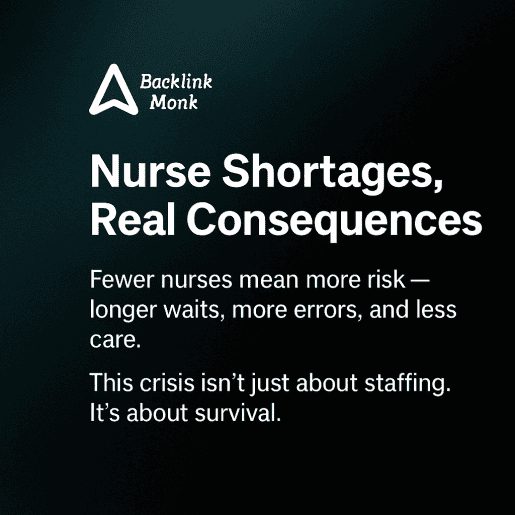
These effects, however, are not the only impact on patient care. There is a more profound effect on the nurse-patient relationship. Nurses who are stretched beyond optimal levels of patient care have limited time for caring activities that are mentally and physically demanding. Family members of patients in the hospital have become more vocal about the feeling that their loved ones are getting “assembly line care,” receiving insufficient scaffolding around care.
Even non-clinical staff in the hospital are feeling the impact of nursing shortages. In understaffed hospitals, delays in transitions from the emergency department to inpatient units are increasing. The average in these understaffed hospitals is an additional 87 minutes. Meanwhile, overwhelmed nursing staff often ignore discharge planning, which is crucial for effective transitions of care, thereby possibly increasing readmission rates.
Conclusion
One of the overwhelming hurdles hospitals need to tackle is the nursing shortage, for example. The roots of this problem are multi-factorial, and solving them with a single step will require strategic work and dedication from all the leaders in healthcare, education, and politics. Currently, it is common knowledge that tending to the future of hospital care revolves around rebuilding a robust nursing workforce that is able and ready to manage complex healthcare problems of an elderly and multi-morbidity patient population. Institutions focusing on these challenges will improve patient outcomes and simultaneously develop sustainable strategies for delivering healthcare services.


We’re a bunch of volunteers and starting a brand new scheme in our community. Your web site provided us with useful info to paintings on. You’ve done an impressive activity and our whole neighborhood might be thankful to you.