Artificial intelligence in medical diagnosis is reshaping the way patients are diagnosed and treated as it helps in predicting disease before the symptoms appear to Complex decision makings for the doctors and it has emerged as the most revolutionary change in the modern healthcare scenario. In AI, medical diagnosis is different from traditional methods as in traditional methods, the outcome relies heavily on manual interpretation, whereas AI systems use advanced algorithms, big data and machine learning to deliver quick and more precise insights.
As we know the population across the globe is increasing and so the load of patients is also increasing on Healthcare institutions that already has a limited resources & capacity which can lead to medical errors but by using AI systems, Healthcare issues can be identified earlier and more accurately as it uses vast data sets including medical images, clinical records, genetic information and even wearable technology inputs.
In this blog, we will explore the role of artificial intelligence in medical diagnosis as well as its challenges, benefits, ethical aspects and the future of AI-assisted healthcare.
What is Artificial Intelligence in Medical Diagnosis?
Artificial intelligence is the ability of the machine and computer systems to replicate the human cognitive functions like learning, reasoning and problem-solving skills and in the context of medical diagnosis, AI applications are mainly designed to analyze medical data and provide the results that can lead to better outcomes for patients and ultimately will help doctors in making decisions.
Some of the technologies that are used for artificial intelligence in medical diagnosis are machine learning, deep learning & natural language processing, and artificial intelligence helps in bridging the gap between growing healthcare demands and limited professional resources by combining these three technologies
Why Artificial Intelligence Matters in Healthcare?
In today’s landscape, healthcare services are facing multiple challenges like shortage of medical staff, rising patient expectations, high costs and issues of Diagnostic accuracy, and according to the World Health Organisation, diagnostic errors can affect around 10% of the patients worldwide and this misdiagnosis can lead to delayed treatment, worse conditions or even preventable death.
Artificial Intelligence can address this concern in such a way that traditional methods won’t be able to do like:
Accuracy: Artificial Intelligence uses millions of data sets much more faster than human which ultimately reduces the chances of overlooking subtle patterns.
Speed: AI can identify the disease much earlier than traditional methods and the early identification of such diseases like cancer, stroke and heart disease that may lead to improvement in survival rates significantly.
Cost Effectiveness: Use of AI is cost effective as it reduces the burden on healthcare facilities and cuts down unnecessary tests
Accessibility: AI powered tools in medical diagnosis can also provide remote diagnostic support to those regions that have insufficient medical specialists or equipments.
Applications of artificial intelligence in medical diagnosis
Medical Imaging and Radiology
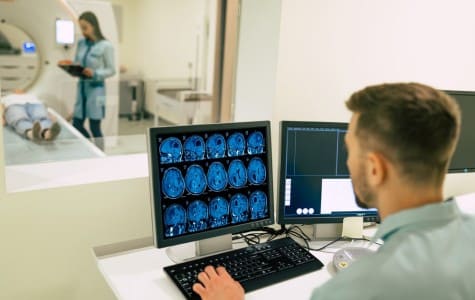
AI in medical diagnosis has benefited the medical imaging the most as deep learning algorithms are now being used to analyse radio graphic images that provides results equivalent or more accurate than trained radiologist for example, AI can detect lung cancer nodules in city scans as well as it can identify early stage breast cancer through memograms and by diagnosing brain tumors or hemorrhages through MRI scans. This ability of artificial intelligence to spot visual patterns that might have escape the Human eye has made medical imaging one of the most successful field of AI applications.
Pathology and laboratory medicine
AI powered diagnostic tools play an important role in pathology and laboratory medicine as it analyses thousands of tissue samples to find any abnormal cells that might signal a disease like cancer and they can process high resolution tissue slides within seconds that cuts down the diagnostic time and ultimately reduces the burden on healthcare institutions.
Predictive diagnosis and preventive Healthcare
By analysing the patient data, family history and even Lifestyle factors AI can predict the likelihood of conditions like cardiovascular disease, diabetes or neurological disorders which makes it one of the most exciting areas of AI in predictive diagnosis. Preventive diagnosis helps the patients to take timely steps to avoid serious complications and today AI is receiving this landscape.
Virtual health assistant
Nowadays, AI driven chat box and applications are in great use by hospitals as it can guide patients by analysing symptoms, recommending initial Diagnostic test or even suggesting when urgent medical attention is required and the systems may at as the first layer of health care support and reduce unnecessary Hospital visits
Genomics and Precision Medicine
To diagnose rare diseases traditional methods of an encounter challenges but a I can easily assist in decoding them as well as in Precision medicine a I can help in creating a diagnosis and treatment plants that is specific to the patients genetic maker which will ultimately lead to more personalised and effective Healthcare treatment
Benefits and Challenges of AI in Medical Diagnosis
There are various benefits of using artificial intelligence in medical diagnosis like it has high Diagnostic accuracy, enhanced efficiency, empowering Healthcare professionals with detailed data insights, 24/7 availability, and data driven insights that go beyond diagnosis.
There are various challenges of using artificial intelligence in diagnosis like data privacy and security, bias in algorithm, ethical concerns, integration issues and lastly the high cost of implementation.
Ethical and Legal Considerations
The use of artificial intelligence in medical diagnosis also ages some questions about ethics and responsibilities like
Accountability: then who will take the responsibility whether it will be the doctor, Hospital, or the AI developer.
Transparency: artificial intelligence provides data on machine learning models and most of them are black box systems that means a doctor will not be able to understand how the AI has reached a specific conclusion
Patient consent: patient consent needs to be taken for using artificial intelligence tools in the Diagnostic process and only if the agree to the data being used for coming to the conclusion.
Future of Artificial Intelligence in Medical Diagnosis
The future holds a very bright prospects for AI powered Diagnostics and some of the expected development includes:
AI integrated hospitals: these hospitals and also be called a smart Hospital where AI will constantly monitor the patient through real time data and will rays and alarm if it find something suspicious which will save a lot of resources as well as well help in taking early decisions for the illness.
Personalised diagnostics: as we have read, If the genomics data like patient medical history or family history is provided to the AI tools then it can provide with extremely personalised disease detection as well as recommend the personalized solution
Wearable AI devices: even in the present time, variable devices are using AI to detect the health of the person and it can monitor the patient vitals continuously as well as can issue and alert before the emergency arises
AI assistant surgery: hospitals are currently doing minimally invasive surgeries and diagnosis during procedures and many of these robotic surgery are powered by AI algorithms
Global accessibility: AI tele medicine platform will bring advanced Diagnostic capability to underserve regions worldwide and will help the mankind by increasing the life expectancy.
These advancements suggest that the artificial intelligence in medical diagnosis can do a real magic and AI will continue to complement, not replace, Healthcare professionals and will ensure faster, say for and more reliable medical care.
Conclusion
Artificial intelligence in medical diagnosis Is no longer an idea of the future but it is already saving the lives today by improving accuracy, reducing the cost and offering preventive care options and AI is addressing some of the most important issues in today’s Healthcare systems worldwide. while there are some challenges like ethical concerns, data bias and integration hurdle remain, ongoing Research and regulations will ensure that a i becomes and indispensable ally in Healthcare providers but not replacement. as Technology continuous to evolve the coordination between the doctors and AI promises a future where medical errors will decrease and patient outcomes will improve that will lead to more personalised, efficient and accessible Healthcare.